Facilitation is often treated as an instinct: something a person either has or doesn’t. The Guild takes a different position. Skilled facilitation is a learnable, observable craft, built from specific knowledge, practiced skill, and consistent behavior.
The Essential Facilitator Competency System makes that craft visible, so it can be named, developed, and recognized. It gives facilitators an honest, structured way to guide their own growth. Rather than relying on vague feedback or informal reputation, a facilitator can look across six domains and five levels of mastery and ask three questions: Where am I strong? Where am I still developing? What would meaningfully deepen my practice?
That clarity is the point. A shared language replaces guesswork, and demonstrated capability matters more than collecting credentials.
Who the system serves
- Individual facilitators, early in the craft or many years in, can take honest stock of where their practice stands, rather than guessing from comfort or confidence.
- Organizations that train or employ facilitators can use the domains as a common language for staff development and for describing what a role requires.
- Organizations that hire or contract facilitators can describe the skills an engagement actually needs, instead of relying on years of experience as a rough proxy.
- People considering involvement with the Guild can see, in plain terms, what developing along this path involves before committing to it.
The six Essential Competency Domains
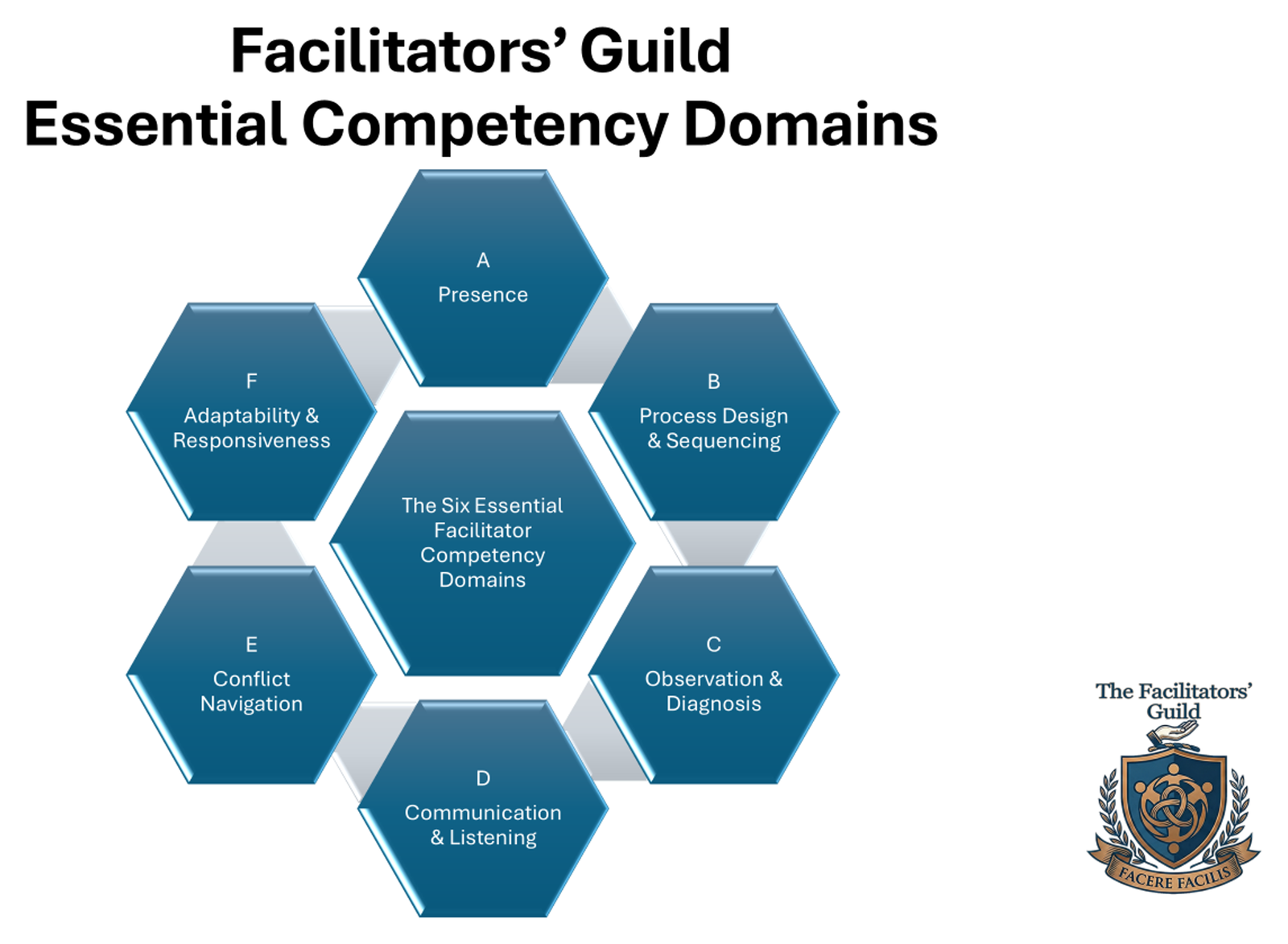
Six domains describe what a facilitator does. Each combines knowledge, skill, and observable behavior.
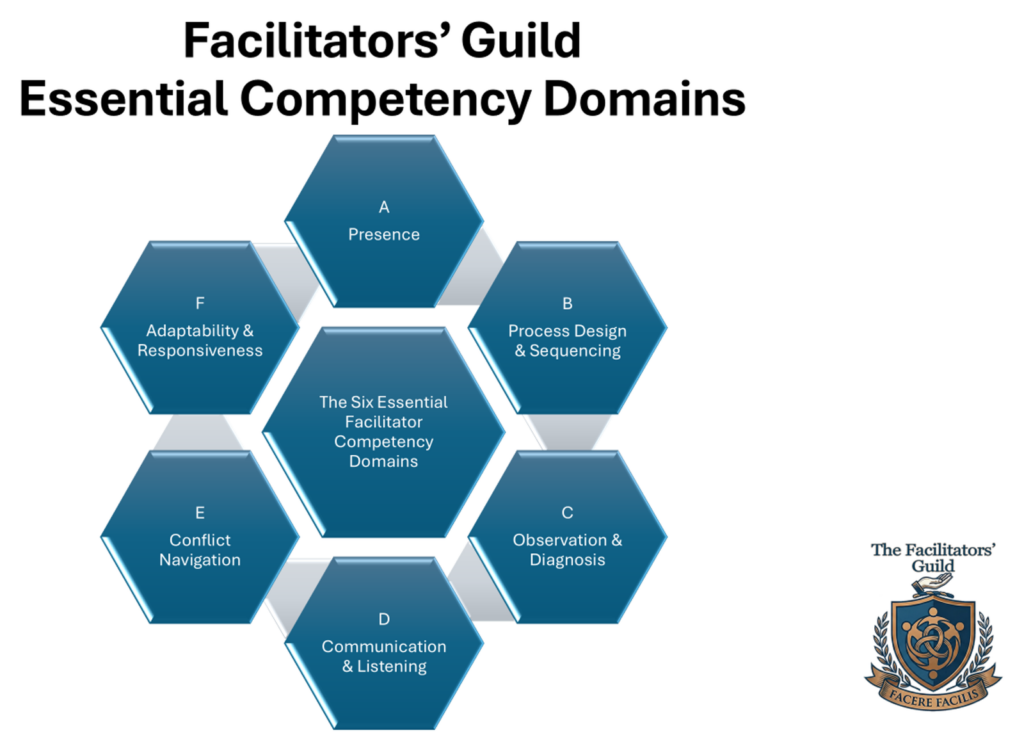
A. Presence
Staying authentically present while acting as a neutral process guide: managing personal bias and trusting the group’s own wisdom.
In practice: Staying regulated under pressure, being honest about your role and influence, and showing up as a real person rather than a persona.
B. Process Design & Sequencing
Creating intentional structures that make collaboration easier, ordered logically toward specific goals.
In practice: Defining clear outcomes, sequencing activities from simple to complex, designing for the group’s actual stage, and adjusting the plan in real time.
C. Observation & Diagnosis
Reading group dynamics, power structures, and underlying patterns rather than only surface behavior.
In practice: Noticing what isn’t being said, spotting power imbalances and inviting quieter voices, monitoring safety, and catching your own projections.
D. Communication & Listening
Helping a group surface its own wisdom through deep listening and thoughtful inquiry.
In practice: Listening fully, asking open questions that deepen thinking, paraphrasing to confirm understanding, and guiding structured reflection.
E. Conflict Navigation
Intervening strategically during disagreement, and treating conflict as useful information rather than failure.
In practice: Naming conflict early, staying calm under heat, making honest disagreement safe, and guiding groups toward real closure.
F. Adaptability & Responsiveness
Changing plans in the moment based on what the group actually needs, and holding the agenda loosely.
In practice: Reading energy moment to moment, improvising from grounding rather than panic, and knowing when to step back and trust the group.
The five Levels of Mastery
Five levels describe how a facilitator’s command of the six domains deepens over years of practice, feedback, and mentorship. Mastery grows through increasing depth, judgment, and adaptability, and through integrating knowledge, skill, and behavior.
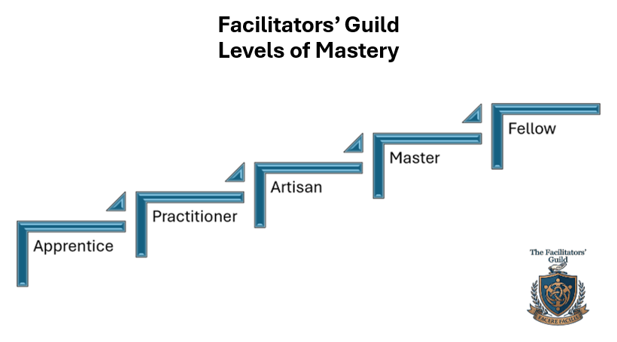
- Apprentice: rule-following and procedural safety. Presence means basic self-management, design means working from proven models, and safety comes from following guidelines closely.
- Practitioner: tactical flexibility. The facilitator reads room timing and group stamina, prepares backup activities, and adjusts pace when a session begins to drag.
- Artisan: self-reflective craft. The facilitator notices their own blind spots, reads underlying group needs in real time, and lets go of rigid control so the group can organize itself.
- Master: systemic transformation. The facilitator holds high-stakes polarization safely, working from integrated intuition and real-time improvisation to help a group create solutions under pressure.
- Fellow: generative stewardship. Mastery becomes an almost invisible, grounding presence, in service of long-term collective change and the future of the craft.
Advancement is not a matter of finishing a course or logging a fixed number of hours, though experience matters. It shows in what a facilitator does differently in the room. The levels describe development, not credentials. Each domain also deepens on its own path: Presence matures differently than Conflict Navigation, and neither follows a generic novice-to-expert arc.
How the system works
A system, not a checklist
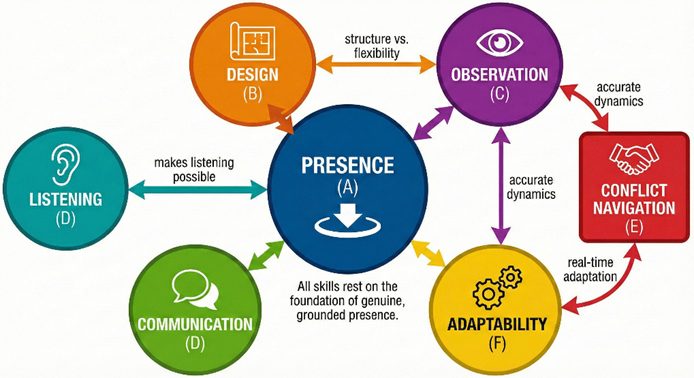
It is tempting to read the six domains as six separate skills to acquire one at a time, or the five levels as a ladder to climb rung by rung. Neither reading captures how the system works. The domains are interdependent, and growth in one often makes growth in another possible.
Presence is the clearest example. A facilitator cannot listen deeply while caught up in their own reactions, read a group’s subtext while defending their ego, or navigate conflict well while dysregulated. Presence is the ground the other five domains stand on. In the same way, strong process design means little without the adaptability to set a plan aside when it stops serving the group, and sharp observation matters only when it shapes how a facilitator communicates and intervenes.
Progress rarely comes evenly. A facilitator might sharpen their conflict navigation for a season while their process design holds steady, then find that design needs attention next. That unevenness is not a flaw in the system. It is what real development looks like. At the higher levels, the domains stop operating side by side and begin working as one. The domains are a useful map, but the map is not the territory: the territory is one room, all at once.
Be intentional about your growth
The framework only helps if a facilitator uses it. Growth rarely happens by accident. It happens when a facilitator looks honestly across all six domains, names where they are strong and where they are still developing, and then seeks out the practice, feedback, and mentorship that closes the gap on purpose.
Photo slot (editor note, not shown to visitors): a mentoring conversation between two facilitators (candidate photo pending approval). Replace this box with an approved photo.
Revisit the domains regularly, not just once. Find a mentor or peer who will tell you the truth about your blind spots. Put yourself in rooms that stretch you past your current level. Mastery in this craft is not a credential to collect. It is a discipline to keep returning to, one deliberate season of practice at a time.
How organizations can use the framework
Because the six domains and five levels describe facilitation in specific, observable terms, they give organizations a shared language for conversations that are often vague.
- Facilitator development: the domains can serve as the backbone for staff training and mentoring, with growth described in observable behavior rather than tenure.
- Shared competency language: people trained in different programs can describe and recognize each other’s skills in the same terms.
- Training alignment: programs can map their content to the domains to see what they cover well and where gaps remain.
- Hiring and contracting: job descriptions, requests for proposals, and reference conversations can name the capabilities an engagement actually needs.
- Professional reflection: teams can use the domains to debrief sessions and plan their own development.
The framework supports these conversations. It does not predict outcomes, and it does not replace an organization’s own judgment or the credentials and training programs already serving the field.
Related Guild resources
- Foundations Behind the Guild: the research, models, and practice the system draws on.
- The Story Behind the Guild: how the system and the Guild came to be.
- About the Facilitators’ Guild: what the Guild is, what it believes, and its place in the field.
Specialty Competencies
Good facilitation looks a little different on a ropes course than it does in a boardroom. Specialty maps start from the Essential Competency System and show you which competencies to grow for the setting you work in.
Explore the specialty maps