The Facilitators’ Guild
Facere Facilis — To Make Easy
A community of practitioners committed to the craft of facilitation and the continuing development of those who practice it.
What is the Facilitators’ Guild?
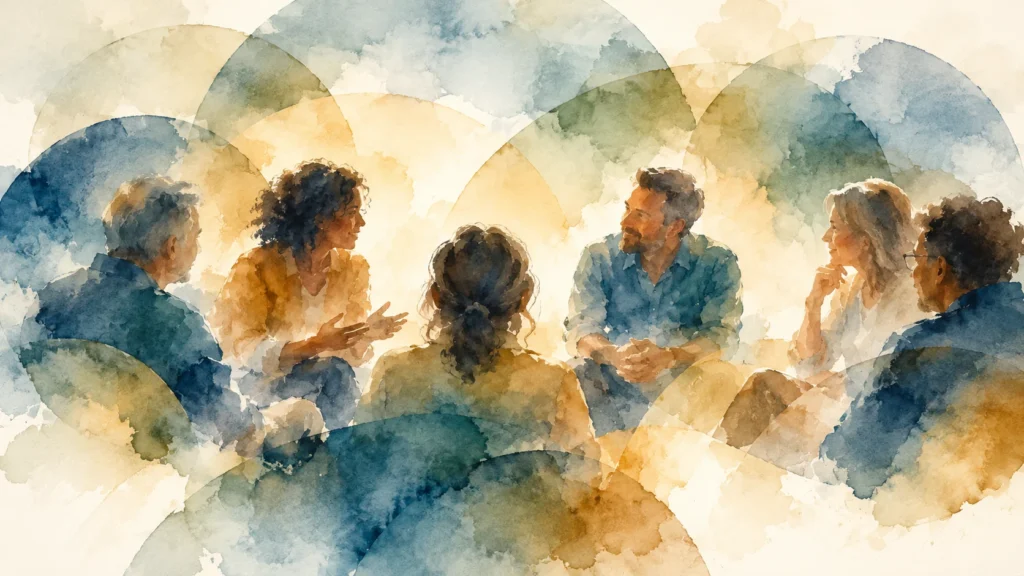
The Facilitators’ Guild brings together people who care about facilitation: the work of helping groups think, learn, decide, and act together. They facilitate in many settings and disciplines, and bring different backgrounds and approaches to the work.
The Guild is a place for shared learning, reflection, and practice, and for the continuing development of facilitation as a craft. It is not a certification body or a training provider. It exists to support facilitators and the conversations that help the practice grow.
Facere Facilis
To make easy
Facilitators don’t do a group’s thinking for it. They create the conditions in which the group can do that work itself.
The word facilitate comes from the Latin facilis, “easy,” rooted in facere, “to make.” Yet making the work easy is not the same as removing every difficulty. Real progress often asks a group to work honestly through hard problems.
The Guild calls this the Facilitator’s Paradox: holding a space strong enough for real struggle, without doing the struggling for the group.
Learning Together, Growing the Craft
Facilitation develops through experience, reflection, and connection with others who practice the craft. The Guild brings together facilitators with different backgrounds and perspectives to exchange ideas, learn from experience, and contribute to one another’s growth.
That learning is practical. Facilitators share what worked and what didn’t, reflect honestly on real sessions, give and receive feedback, and mentor one another. People who work in different settings and traditions often see the same moment differently, and those differences are part of how the craft grows.
The Essential Facilitator Competency System
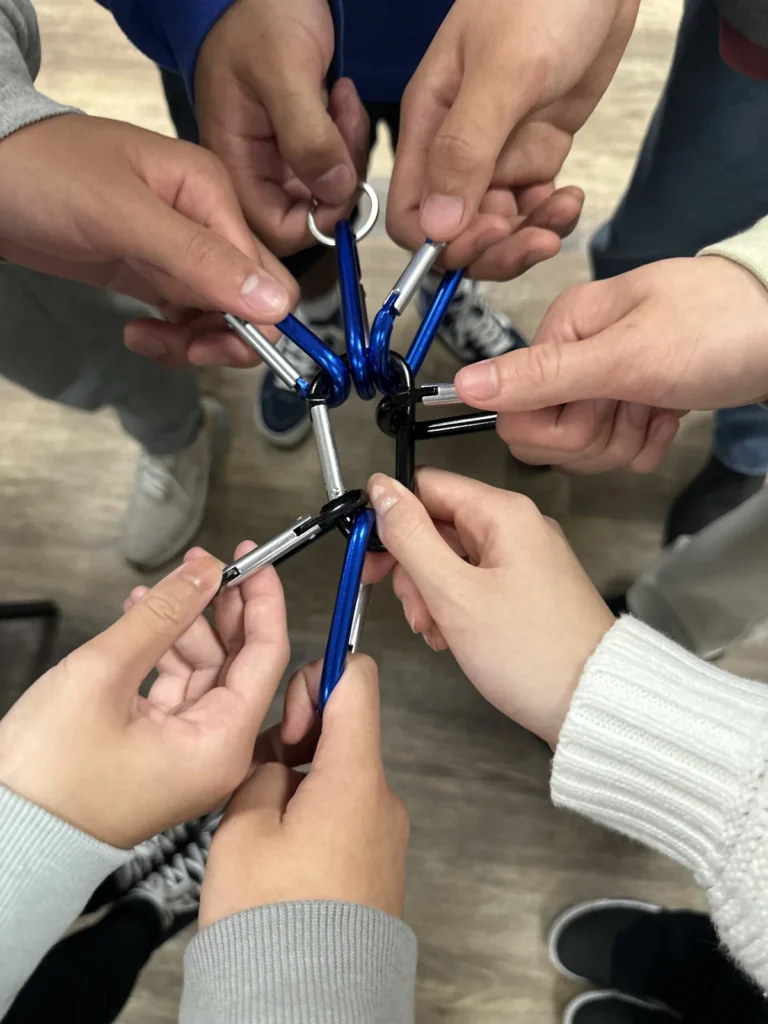
The Essential Facilitator Competency System gives facilitators, and the organizations they work with, a shared framework for understanding and developing facilitation capability.
It starts from a simple position: skilled facilitation is a learnable, observable craft, built from knowledge, practiced skill, and consistent behavior, and refined through practice and judgment. The system makes that craft visible, so it can be named, discussed, and deliberately developed.
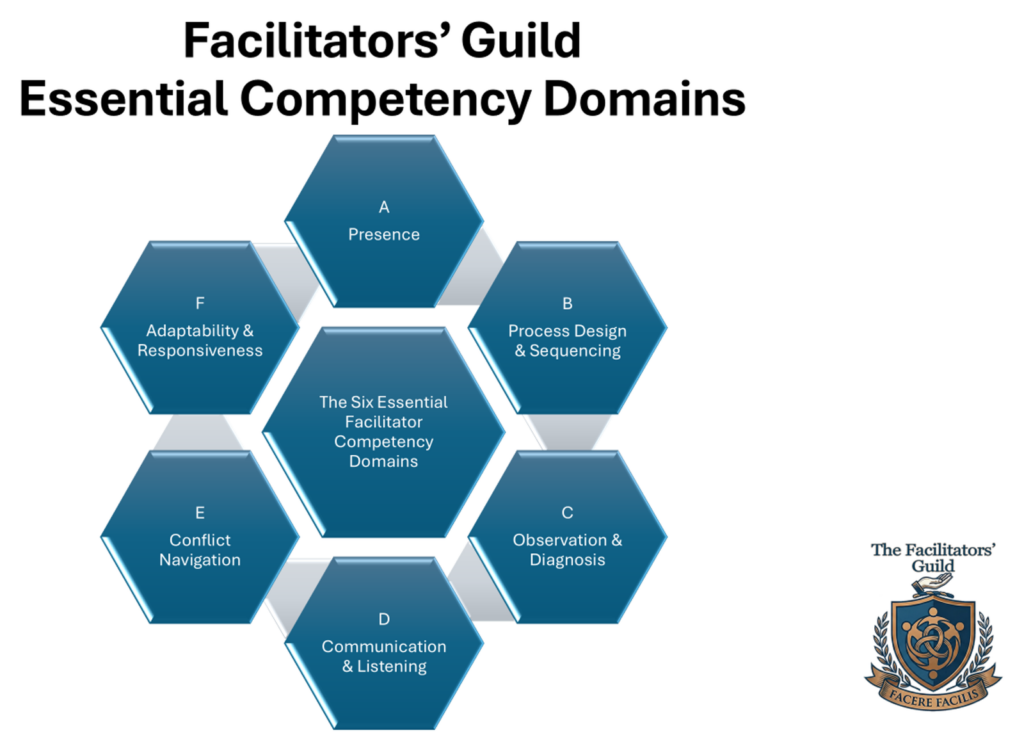
Six competency domains describe what a facilitator does:
- Presence
- Process Design & Sequencing
- Observation & Diagnosis
- Communication & Listening
- Conflict Navigation
- Adaptability & Responsiveness
Five levels of mastery, from Apprentice through Practitioner, Artisan, and Master to Fellow, describe how that practice deepens over time. The system complements existing training programs, professional associations, and credentials rather than replacing them.
The Foundations Behind the Guild
The Guild did not set out to invent a new theory of facilitation. Its framework draws on established thinking about learning and development, group dynamics, communication and listening, systems thinking, conflict, adaptive practice, and the growth of experience into mastery. Each idea was then tested against what experienced facilitators actually do.
Foundation
Essential Facilitator Competencies
A high-level introduction to the competency system and the thinking behind it.
Foundation
Levels of Mastery
How facilitation practice deepens across five levels, from Apprentice to Fellow.
The Story Behind the Guild
The Guild began with a question: what holds true in every room where people work together, whatever the setting? Guild founding member John Losey started asking it in 2007, and spent almost twenty years testing ideas in corporate strategy sessions, community conflicts, and wilderness courses.
In 2024, a wider circle of facilitators began comparing notes and trying the ideas in their own work. The Competency System grew out of that collaboration, and the Facilitators’ Guild followed in January 2026.
The craft grows through practice and connection.
The Facilitators’ Guild is a place to explore the craft of facilitation, learn from different perspectives, and contribute to conversations about what it means to facilitate well.